

World Development Information Day: Empowering Growth Through Knowledge
Information connects us.
Wisdom elevates us.
Let’s use both to build a world that grows with integrity. #WorldDevelopmentInformationDay
World Development Information Day — Empowering Growth Through Knowledge
Every year on October 24, the world observes World Development Information Day, a moment to reflect on how access to knowledge and accurate information shapes the path toward global progress. Established by the United Nations in 1972, this day serves as a reminder that sustainable development is not only about financial resources or infrastructure- it begins with awareness, understanding, and informed action.
In today’s interconnected world, information has become one of the most powerful tools for transformation. From policymaking and education to innovation and finance, knowledge guides every meaningful step forward. Yet, the true strength of information lies not merely in its abundance, but in how it is used wisely- to inspire change, solve problems, and empower communities.
Modern societies thrive not just on capital or technology, but on the wisdom to use information responsibly. When knowledge is shared with purpose and applied with integrity, it becomes more than data, it becomes a force for ethical growth. This day has long inspired individuals, institutions, and nations to share information as a means of building a more conscious and connected world. The ripple effect of that mission continues- empowering people to exchange ideas, educate one another, and turn awareness into progress.
At Hakeem, we carry this same spirit forward. Through our philosophy of Hikmah, wisdom applied with purpose, we aim to ensure that this cycle of knowledge and growth continues for generations to come. By transforming financial information into ethical, actionable insight, Hakeem seeks to nurture a world where understanding leads to empowerment, and empowerment leads to enduring development.
The Power of Information in Building a Better World
Information has always been at the heart of progress. When accurate, reliable, and accessible data reaches the right hands, it becomes the foundation upon which nations plan their economies, communities advance their well-being, and individuals unlock new opportunities. From economic policymaking and social reform to financial inclusion and digital innovation, informed decisions drive sustainable growth at every level of society.
In recent decades, the world has witnessed an unprecedented explosion of information, an era often described as the Information Age. Yet, despite having more data than ever before, true understanding often feels harder to find. Misinformation spreads faster than truth, and complexity frequently overshadows clarity. The real challenge today is not access to information, but the wisdom to discern, interpret, and apply it effectively.
As the visionary writer Isaac Asimov once observed, “The saddest aspect of life right now is that science gathers knowledge faster than society gathers wisdom.” His words perfectly capture today’s reality and this reflection urges us to look beyond data accumulation and focus on transforming knowledge into wisdom- the kind that uplifts societies and guides ethical progress. Meaningful development begins not when information is abundant, but when it is applied with purpose, empowering people to act consciously, collaborate responsibly, and build a world grounded in understanding rather than noise.
From Information to Hikmah: The Hakeem Philosophy
In Islamic and philosophical tradition, Hikmah means far more than knowledge- it signifies wisdom, or the ability to apply knowledge with ethics, balance, and purpose. It is the light that turns mere information into meaningful guidance. In the Qur’anic sense, Hikmah is both divine and practical: it shapes character, refines judgment, and ensures that learning leads to justice and benefit for society.
In today’s fast-paced digital age, we are surrounded by endless data: market reports, statistics, financial trends, and algorithmic predictions. This abundance of information is valuable, yet without Hikmah, it risks becoming directionless. Hikmah by Hakeem was founded to bridge that very gap, transforming raw data into purposeful insight that serves people, not just systems.
At Hakeem, the journey is clear:
- Information represents numbers, figures, and financial data- the what.
- Hikmah represents understanding, decision-making, and ethical finance- the why and how.
By applying Hikmah to every layer of financial technology and education, Hakeem ensures that innovation remains rooted in values. It’s not about chasing trends- it’s about creating systems of trust, where every financial decision aligns with Shariah principles, social responsibility, and long-term sustainability.
Empowering Growth Through Ethical Financial Knowledge
The message of World Development Information Day extends far beyond technology and communication- it’s a call to use information wisely to create equitable and sustainable progress. One of the most powerful expressions of this idea lies in ethical financial knowledge. When people understand how money moves, how it is earned, managed, invested, and shared; they gain the ability to direct their own futures and contribute meaningfully to their communities.
Financial awareness is more than a personal skill; it is a cornerstone of sustainable development. Yet, awareness must be guided by ethics- ensuring that knowledge serves humanity rather than exploitation. In an era of rapid digital transformation, where access to financial tools is expanding faster than understanding, this balance has never been more critical.
By encouraging the responsible use of information, especially in finance, we create a world where development is both empowering and ethical. This is the spirit of World Development Information Day: transforming knowledge into action that uplifts not just economies, but the values that sustain them.
Technology as a Tool for Empowerment
In an age defined by information and connection, technology has become one of humanity’s greatest enablers of growth. Once limited by geography and access, information now travels freely- crossing borders and connecting people in real time. It has become more than a medium for communication; it is the engine of global development, driving innovation across every sector.
From farmers monitoring weather data on mobile devices to students accessing world-class education online, technology has made knowledge a shared resource rather than a privilege. Open data systems, digital finance, and AI-driven analytics have enhanced transparency, efficiency, and collaboration- empowering individuals and institutions alike to make smarter, faster, and more inclusive decisions.
Yet, technology’s value is not defined by speed or scale alone. While automation and AI expand access to knowledge and efficiency, they also remind us that true progress requires discernment. When decisions are left entirely to algorithms, the human element of empathy, ethics, and context, risks being overlooked. The challenge, therefore, is not to resist technology but to shape it consciously- ensuring that innovation complements human judgment rather than replaces it.
This is the principle that guides Hakeem’s approach to technology, using AI not as a replacement for human wisdom, but as a tool that strengthens it. Every system is designed to reflect Hikmah– aligning intelligent automation with ethical intention, so that insight remains both human and humane. When guided by intention and ethics, technology still holds the power to strengthen human capacity rather than weaken it. It can free time for creativity, deepen collaboration, and support decisions grounded in insight rather than impulse. In this balance lies its true promise: not to make humanity dependent, but to make it more discerning- capable of turning information into understanding, and progress into purpose.
Building a Future Guided by Hikmah
As the world continues to evolve through information and technology, the measure of progress will not be how fast we innovate, but how wisely we apply what we know. Sustainable development, whether economic, social, or digital, depends on our ability to pair intelligence with integrity, and data with discernment.
Hikmah, or wisdom, remains the bridge between knowledge and impact. It transforms raw information into purposeful action, ensuring that growth is rooted in understanding rather than speed. In an era where algorithms predict behavior and machines assist in decision-making, Hikmah reminds us that true advancement begins with consciousness- the awareness of how our choices shape both humanity and the generations to come.
At Hakeem, this principle defines every innovation and insight. By embedding ethics, empathy, and foresight into technology, Hakeem seeks to create systems that do more than perform- systems that understand, uplift, and sustain. As we reflect on the spirit of World Development Information Day, one message endures: information alone can build connections, but wisdom builds communities. The future belongs to those who not only seek knowledge, but who use it with purpose- to empower, to enlighten, and to ensure that progress remains rooted in humanity.

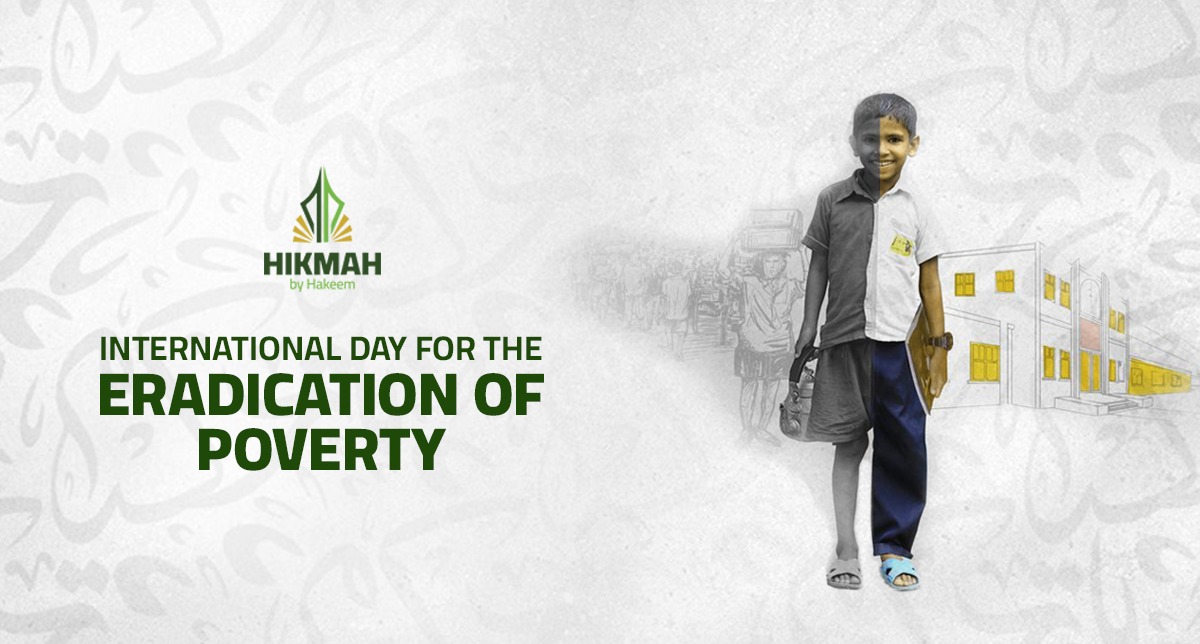
From Poverty to Prosperity: Empowering the Unbanked.
Every year on October 17, the world observes the International Day for the Eradication of Poverty- a moment to reflect on one of humanity’s greatest challenges. Yet today, poverty is not only about a lack of income. It’s increasingly about a lack of access- to opportunity, to fair systems, and most importantly, to finance. Despite decades of progress, over 1.4 billion people remain unbanked, without access to even the most basic financial services like a bank account, digital wallet, or credit.
Millions more are underserved, relying on cash, informal loans, or costly remittance channels. This isn’t just a financial problem- it’s a barrier to equality, education, and empowerment. When someone cannot safely save money, receive payments, or access small loans, they remain trapped in a cycle of dependency. Their potential stays locked away, not because of lack of talent or effort, but because of a lack of tools.
Who Are the Unbanked?
For many of us, opening a bank account or transferring money online feels simple, almost routine. But for nearly one in four adults globally, those options don’t exist. These are the unbanked, individuals with no access to formal financial services, and the underbanked, who have limited or unreliable access. Together, they represent a silent majority excluded from the very systems that drive modern economic growth, with a shared barrier: exclusion. These can include:
- Rural communities cut off from banking infrastructure.
- Migrant workers sending remittances through informal channels.
- Women in developing nations without financial autonomy.
- Small entrepreneurs who cannot secure even the smallest loans to expand.
- Refugees and undocumented workers locked out by identification or residency requirements.
Being unbanked comes with hidden costs that deepen poverty:
- No safe place to save: Cash savings are vulnerable to theft, loss, or inflation.
- Limited access to credit: Without formal financial records, loans become inaccessible or exploitatively expensive.
- Higher transaction costs: Informal money transfers and payday lending charge far higher fees.
- Missed opportunities: Without access to banking, people cannot invest, build credit, or join the digital economy.
Without access to reliable financial tools, the poor remain trapped. They cannot borrow to start businesses, cannot save to secure their future, and cannot insure themselves against emergencies. Financial exclusion thus becomes both a symptom and a cause of poverty- perpetuating a cycle that economic growth alone cannot break. As the world advances in digital innovation and fintech, this divide becomes even more striking. Now the question is not just why poverty persists but also why financial access still doesn’t reach everyone.
Breaking the Cycle: Financial Inclusion as a Tool for Change
Financial inclusion is the bridge to opportunity. It gives individuals the power to participate in the economy, not as bystanders, but as active contributors. When people can safely save, access financing, and move money securely, they begin to shape their own future. A farmer can buy better seeds. A mother can invest in her children’s education. A small shop owner can expand his business instead of merely surviving day to day.
True inclusion goes beyond opening bank accounts; it’s about building trust, fairness, and accessibility into the financial system itself. Traditional banking often excludes those without formal documentation or collateral, but inclusive systems meet people where they are- through mobile technology, microfinance, and community-based partnerships. This access creates ripple effects: increased resilience, reduced inequality, and stronger local economies. When financial doors open, hope follows.
Islamic banking offers a particularly powerful model for inclusion, one that is slowly expanding beyond Muslim-majority regions. Built on the principles of justice, transparency, and shared prosperity, Islamic finance rejects exploitative interest and speculative transactions. Instead, it promotes ethical and asset-backed investments that ensure money serves real economic activity.
Beyond its technical structures, Islamic finance carries a moral philosophy- that wealth should circulate for the benefit of society. Mechanisms such as zakat (obligatory charity) and waqf (endowment) have, for centuries, been tools for poverty reduction, education, and social welfare. In modern times, these principles are being reimagined through fintech innovation. Digital platforms can now channel zakat contributions directly into micro finance, fund community projects, or provide emergency support with full transparency.
Innovations Reshaping Access
Across the world, a quiet revolution is unfolding- one powered not by banks or bureaucracies, but by technology and inclusion. The rise of digital finance has shown that poverty is not only a lack of income, but often a lack of connection. In places where traditional banking never reached, a simple smartphone can now unlock access to savings, credit, and opportunity. This transformation is redefining what it means to participate in the economy. Mobile banking and digital wallets have brought millions into the financial system, particularly in regions where formal branches are scarce.
Beyond mobile finance, fintech innovation is addressing long-standing barriers to access. Digital identity verification, or e-KYC, allows individuals without traditional documents to open accounts using biometric data or mobile numbers. Blockchain technology is also making remittances faster, cheaper, and more transparent, ensuring that more money reaches families and less is lost to intermediaries. Furthermore, Micro-lending platforms are using artificial intelligence to assess creditworthiness based on alternative data, such as phone usage or utility payments, giving millions their first opportunity to borrow responsibly.
Beyond Access: Building Trust and Literacy
Access alone does not guarantee empowerment. For millions of newly banked individuals, navigating financial systems can feel intimidating, especially when the tools, language, or technology are unfamiliar. Without financial literacy, access can quickly turn into dependency or risk. Trust, too, remains a fragile currency. In many low-income communities, decades of exclusion and exploitation have created deep skepticism toward formal institutions.
People are often more comfortable relying on informal savings circles or local lenders because they know them personally, even if the terms are unfavorable. Overcoming this mistrust requires more than infrastructure, it requires a human connection. Banks, fintechs, and governments must invest not only in platforms, but in people. Financial literacy programs, mentorship initiatives, and community-based education can transform how people relate to money. When individuals understand how to use financial tools safely, whether digital payments, insurance, or micro-investments, they begin to see finance not as a threat, but as a source of empowerment.
Digital innovation can also help accelerate this cultural bridge. Interactive learning apps, storytelling-based financial education, and local-language tutorials are reshaping how knowledge is shared. But technology alone is not enough; empathy must guide its use. A truly inclusive financial system must meet people at their level- respecting their traditions, addressing their fears, and helping them grow with dignity.
Conclusion
The International Day for the Eradication of Poverty is more than a day of awareness, it’s a reminder of our shared responsibility to build systems that include, empower, and uplift. Poverty today is not only a question of income; it’s a question of access. Billions remain outside the gates of the financial world, not because they lack ambition or ability, but because the doors were never built for them.
Financial inclusion is the tool that can change that story. When individuals can save securely, borrow fairly, and invest confidently, they gain the power to break free from survival and move toward prosperity. Yet inclusion without ethics is fragile. That is why models rooted in Islamic finance and ethical fintech are so vital- they ensure that growth does not come at the cost of justice. They remind us that finance, at its best, is not just about profit, but about purpose.
As technology continues to reshape access, the challenge before us is not merely innovation, but intention. Every new product, platform, and policy must ask: who does this empower, and who does it leave behind? True progress will be measured not by how advanced our financial systems become, but by how many people they serve with fairness and dignity.